
Cheat Sheet of Useful Formulae
Pythagoras Theorem
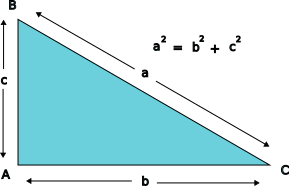 | For a right angled triangle: The square of the length of the hypotenuse (longest side) is equal to the sum of the squares of the lengths of the other two sides. In the diagram shown, the hypotenuse is designated as the length ‘a’ and the other two side lengths are designated as ‘b’ and ‘c’. \( a^2 = b^2 + c^2 \) |
Trigonometric Ratios of a Right Angled Triangle
\[ \sin = \frac{opposite}{hypotenuse} \]
\[ \cos = \frac{adjacent}{hypotenuse} \]
\[ \tan = \frac{opposite}{adjacent} \]
There are a number of mechanisms that people use to remember these formula. The (arguably) most common mechanism used in texts is the acronym SOHCAHTOA (pronounced as “so-car-toe-a“). Which is the concatenation of SOH, CAH, and TOA. Each letter representing the first letter of each of the words Sin, Cos, Tan, Opposite, Adjacent, and Hypotenuse. There being an implied ‘=’ between the first two letters, and ‘divided by’ between the second and third letters of each triplet.
Personally I use a short rhyme that was drummed into me by my math teacher well over 50 years ago.
Should Our Harry
Catch A Herring
Trawling Off America
Which uses the first letter of each word to derive at the SOH, CAH, TOA triplets.
Either way. Armed with these three equations and either two sides or one side and one angle all of the other parameters (of a right angled triangle) can be calculated.
Law of Cosines
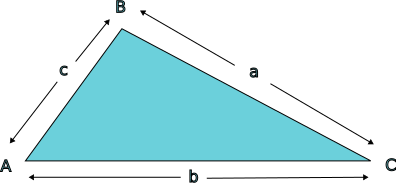 To find the 3rd side: \(\text{SAS => } a^2 = b^2 + c^2 – 2.b.c.\cos(A) \) \( a = \sqrt{b^2 + c^2 – 2.b.c.\cos(A)} \) To find any angle: \(\text{SSS => } A=\arccos(\frac{b^2 + c^2 – a^2}{2.b.c}) \) | Use when two sides and the included angle (SAS) are known to find 3rd side or when all three sides (SSS) are known to find any angle. |
Law of Sines
| To find an angle: \[ \frac{\sin(A)}{a} = \frac{\sin(B)}{b} = \frac{\sin(C)}{c} \] Alternatively to find a side: \[ \frac{a}{\sin(A)} = \frac{b}{\sin(B)} = \frac{c}{\sin(C)} \] 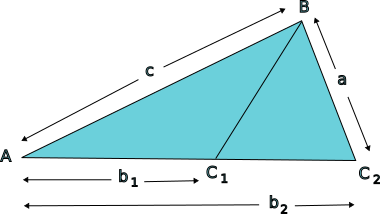 | Use when at least one side with it’s opposite angle (a+A, or b+B, or c+C) and one other side or angle are known. Note that:
|
Law of Tangents
| \[ \frac{a – b}{a + b} = \frac{\tan(\frac{A – B}{2})}{\tan(\frac{A + B}{2})} \] | Use when either SAS or AAS are known. Also can be used for ASA because if you know 2 angles, the 3rd is just 180 – sum of 2 known angles. Hence if you know ASA you also trivially can find AAS. The trick when calculating with SAS is to start with the sum of the two unknown angles (which will be 180 – the known angle ‘C’). From there it is a short step to solving for A – B. At which point summing (A + B) and (A – B) gives 2A. At which point finding A and B individually becomes trivial. Now use the law of sines (or cosines) to find the 3rd side. Calculating for ASA is straight forward, though does often require the manipulation of awkward non-whole numbers. |
Quadratic Formula
| \[ x = \frac{-b \pm \sqrt{b^2 – 4.a.c}}{2.a} \] | This formula is used when the quadratic equation can’t easily be factored. It handles solutions that can be either integers, real numbers or complex (imaginary) numbers. |
Capstan Equation (Eytelwein Formula)
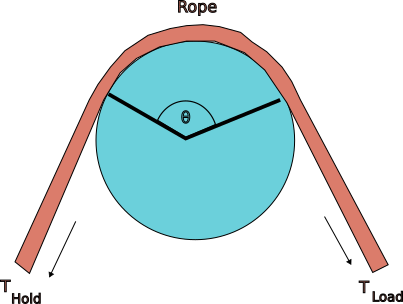 \[ T_{Hold} = \frac{T_{Load}}{e^{\mu\theta}} \] \[ \text{Where:} \] \[ T_{Hold} = \text{ Force required to maintain equilibrium} \] \[ T_{Load} = \text{Force applied by the load} \] \[ e = \text{Base of Natural logarithms (2.7183)} \] \[ \mu = \text{Coeficient of friction between rope and capstan surface} \] \[ \theta = \text{Total angle of wrap measured in radians} \] | Used to calculate the holding power of a capstan (a winch or a drum) for a given number of turns of the rope. In sailing this relates to the number of turns of a ‘sheet’ (rope) are needed to hold against the force of a fully loaded sail full of wind. Surprisingly 3 or 4 turns will hold pretty much any sail. In robotics it relates to the number of turns of a chord required to avoid slippage in capstan drive. Which is a gearbox that uses a rope wrapped around two different sized drums instead of two meshed gears to achieve the reduction. Counter intuitively, the holding power of a capstan is independent of the radius of the cylinder. Mathematically this is due to the fact that the radius appears in both the numerator (for the force) and the denominator (when converting angle to length) and so cancels out completely. Intuitively it can be explained by the fact as the radius increases, so does the length of rope over which the friction acts, but the pressure per square inch holding the rope against the cylinder decreases. Conversely, as the radius reduces, and hence the length of rope over which friction is applied, the pressure per square inch holding the rope against the cylinder increases. Thus, once again the effect of the radius cancels out. |