Category Revision

Various sets of revision notes series

5R-5 Bar, Closed Loop, Linkage
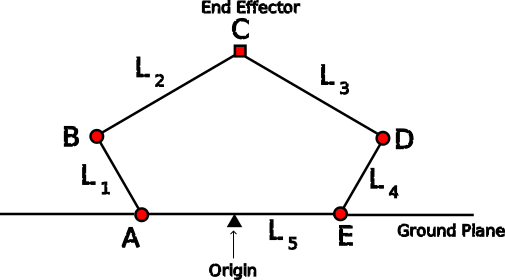
5R-5 Bar Linkage
This entry is part 2 of 2 in the series Robotics Revision

5R-5 Bar, Closed Loop, Linkage A relatively simple mechanism, with the very useful feature of sharing the load between the two powered joints: ‘A’ and ‘E’. It may look like two 2R-2 Bar linkages back-to-back, but it works in a…
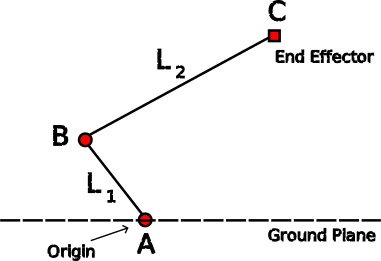
2R-2 Bar Linkage

5R-2 Bar Linkage Diagram
This entry is part 1 of 2 in the series Robotics Revision

2R-2 Bar Linkage Probably the simplest of robotic arm/leg mechanisms. It operates in a 2D space, but can be modified to work in a 3D cylinder of space. Easy to implement, but has several drawbacks which will be discussed later.…

Practical Inductors

This entry is part 24 of 24 in the series Electronics DC Revision

Practical Inductors Before looking at a few of the many types of inductors a few properties of real world inductors should be kept in mind: Inductor Types Air Core Arguably the simplest of all deliberately made inductors. For R.F. applications…

Inductors

This entry is part 22 of 24 in the series Electronics DC Revision

Inductors Electromagnetism – A Quick Introduction An electromagnetic field is the combination of both an electric field and a magnetic field. Both affect each other and both always exist whenever there is a moving electrical charge. However, both can also…

Practical Capacitors

This entry is part 21 of 24 in the series Electronics DC Revision

Practical Capacitors There are a wide variety of capacitor types which use a number of different construction materials. Here is a broad selection of the ind of thing that is available. Capacitor Types Fixed Values Ceramic Disc Made by coating…

Capacitance

This entry is part 19 of 24 in the series Electronics DC Revision

Capacitance What is Capacitance? Before I answer that question, let me start by clearing up something which has the potential to be very confusing… Capacitance has been given the designation C, which, as you will remember from the article on…

Nodal Analysis

This entry is part 18 of 24 in the series Electronics DC Revision

Nodal Analysis The motivation for Nodal Analysis (a.k.a.the Branch Current Method) is that sometimes you have a circuit which is too complicated to solve using a simplification method, such as superposition. Nodal analysis on the other hand will work for any…